Okay, layman here. In summary, so far as I understand, there seem to be 2 positions laid out here on what the GE hypothesis says:
GE requires the death of the organism at some point due to massive amounts of slightly deleterious mutations, leading to extinction.
GE requires the entire population to have less and less capability to reproduce, eventually leading to extinction. (I think PDPrice endorses this view)
If that’s an accurate representation, in addressing (2), could someone explain to me how slightly deleterious mutations could outweigh the selectable beneficial mutations if it’s the case that VSDs (hope that’s the right acronym) effects can’t be measured while those of selectable beneficial mutations can? I mean, isn’t hitchhiking most effective when using beneficial mutations as the vehicle, anyway?
“What the GE hypothesis says” is not really up for debate. Your option 2. is pretty close, but it’s more nuanced than that, since the ability to reproduce is itself only one of many abilities we living things possess. Please keep in mind that many of the people on this forum claiming to address GE have never read anything written by Dr Sanford, least of all his book Genetic Entropy.
The VSDs outweigh selectable beneficials by weighing more … as in, the mutational deck is stacked very heavily in favor of damaging mutations, with beneficial ones only being found on extremely rare occasion. Mutations are mistakes. Mistakes are usually not good.
My suggestion to you is the same one I have for everybody else: read the book.
Not all mutations are mistakes. Mutations are alterations in DNA sequence usually due to replication errors. All mistakes are alterations, but not all alterations are mistakes.
As far as I am concerned, there is no need. GE is specious and not based on reality. You have a chance to convince us, but you are failing badly.
Please keep in mind that it’s not strictly necessary to read his book to understand the concept, and what is wrong with it.
And yet fitness increases can be shown in the real world. Sanford can’t reproduce those sustained fitness gains in his Mendel’s Accountant models using his imagined DFE of mutations, which means the basis for this concept of GE fails to correspond to reality.
Sanford can’t reproduce these kinds of curves with his assumed fixed DFE:
Further still, as I have explained and shown references that substantiate, the DFE of mutations changes as a function of how well adapted an organism becomes. Lowering fitness increases the fitness effects of mutations, both by shifting deleterious mutations to the beneficial side, and by mutations having a larger relative effect at lower compared to higher fitness levels. Sanford also can’t reproduce this empirically demonstrated effect in any of his models or simulations. His GE concept is based on the physically impossible assumption of a fixed DFE.
The VSDs outweigh selectable beneficials by weighing more … as in, the mutational deck is stacked very heavily in favor of damaging mutations, with beneficial ones only being found on extremely rare occasion. Mutations are mistakes. Mistakes are usually not good.
I mean, yeah, I can follow that’s the idea. What I’m not getting is how you can say these VSDs outweigh beneficial mutations if we can’t actually measure their effects.
I may have missed the relevant parts. Care to highlight?
This is false. Replication errors generate mutations (which are alterations, but not necessarily mistakes). Don’t confuse the process with the result. To prevent confusion, explain what you mean by mistake?
I don’t need to read the book when its major premises have been soundly scrutinised here and found wanting. Its basically going to rehash many of the things you have said here. There is no point.
PDPrice has been asked this same question dozens of times in the last few years. He has yet to come up with a response beyond “buy the book!” and waving his arms. The simple fact is GE has been thoroughly discredited and rejected by the scientific community. All we get now is YEC cheerleading.
This is one of the fundamental blunders with the YEC driven GE claims. YECs don’t understand in biology duplication with variation is one of the prime drivers of evolution. No genetic variation would mean no new raw material for selection to act on = no evolution. To YECs anything besides perfect copying is an “error” which in their minds means the God created “perfect” genomes must be degrading. In biology reproducing with variation really is a feature, not a bug.
Pardon me for not following the whole discussion - just ignore me if this point has been made already.
Any natural population is going to have a range of fitness from the start. Some will be more fit than others, and that variability should be enough to allow selection to occur. Minimally there will be purifying selection, casting out fatal mutations. Some slightly negative AND positive mutations will accumulate over time, so even an initially perfect population of clones will soon reach a state where selection can act.
The premise of GE seems to disallow natural variability in fitness, treating the population as identical clones.
Yep. I was wondering about something like that (we see obvious fitness differences between individuals in nature), then at first I assumed this could be solved with an initial created variation that was diminishing following “the fall”. But then I recalled all species are supposed to have gone through a 2-7 member bottleneck on Noah’s ark, which should have massively reduced any initially created variation. And then we’re back to that conflict I keep seeing between Sanford and Jeanson’s “models”.
I’d leave the other stuff out - we don’t need to argue Noah today.
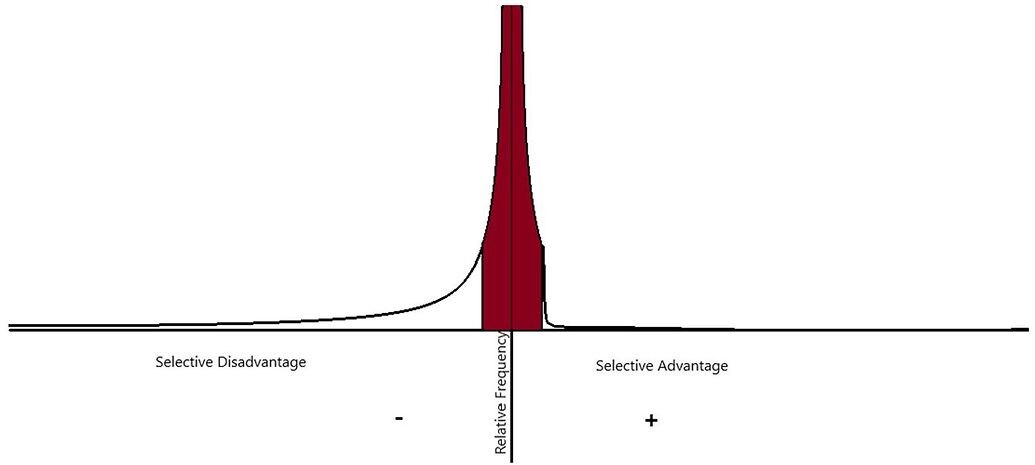
If fitness has a normal distribution or something close to it, then the fitness in the living population is going to look a lot like the shaded area in Dr. glipsnort’ssomebody’s graph …
Actually I can think of situation where it might look a little different - but that doesn’t really matter so much. What matters is the difference between the highest and lowest fitness. IF the variation it is big enough, AND assuming some sort of selective pressure exists (even within-species competition), then selection will occur.
By definition, GE is adding variation to the population. Therefore selection will occur. It’s a self-solving problem.
No. GE doesn’t require a lack of genetic variability, nor does it require a lack of variability in fitness. It just requires that the nearly neutral portion of the genetic variability (which is assumed to be biased toward negative s) is evenly distributed enough that the population doesn’t vary much in just that component of fitness.
Note that your graph doesn’t show the fitness of individuals but of alleles. And the required assumption is that the fitness distribution of nearly neutral alleles is skewed toward the negative.
Selection on non-nearly-neutral alleles has no effect on GE.
Perhaps I didn’t explain what I mean very well. Cumulative nearly-neutral mutations (NNM?) will add variability to a component of fitness. If it was narrowly (evenly?) distributed in fitness to start with, it will not stay narrowly distributed*. There will eventually be enough cumulative variation for selection to act.
Maybe there are biological reasons for a fitness range to be very narrow? The mathematics of cumulative errors implies that variation should increase.
Why? Why would these variations, which would spread neutrally in the population, result in cumulative variation? Neutral standing variation doesn’t tend to increase in a population past a threshold, and remember that the number of these variations fixed in a population each generation is equal to the mutation rate per person. Fixed alleles obviously don’t contribute to variability.
No, it implies that departure from the ancestral condition should increase.

 )
)
