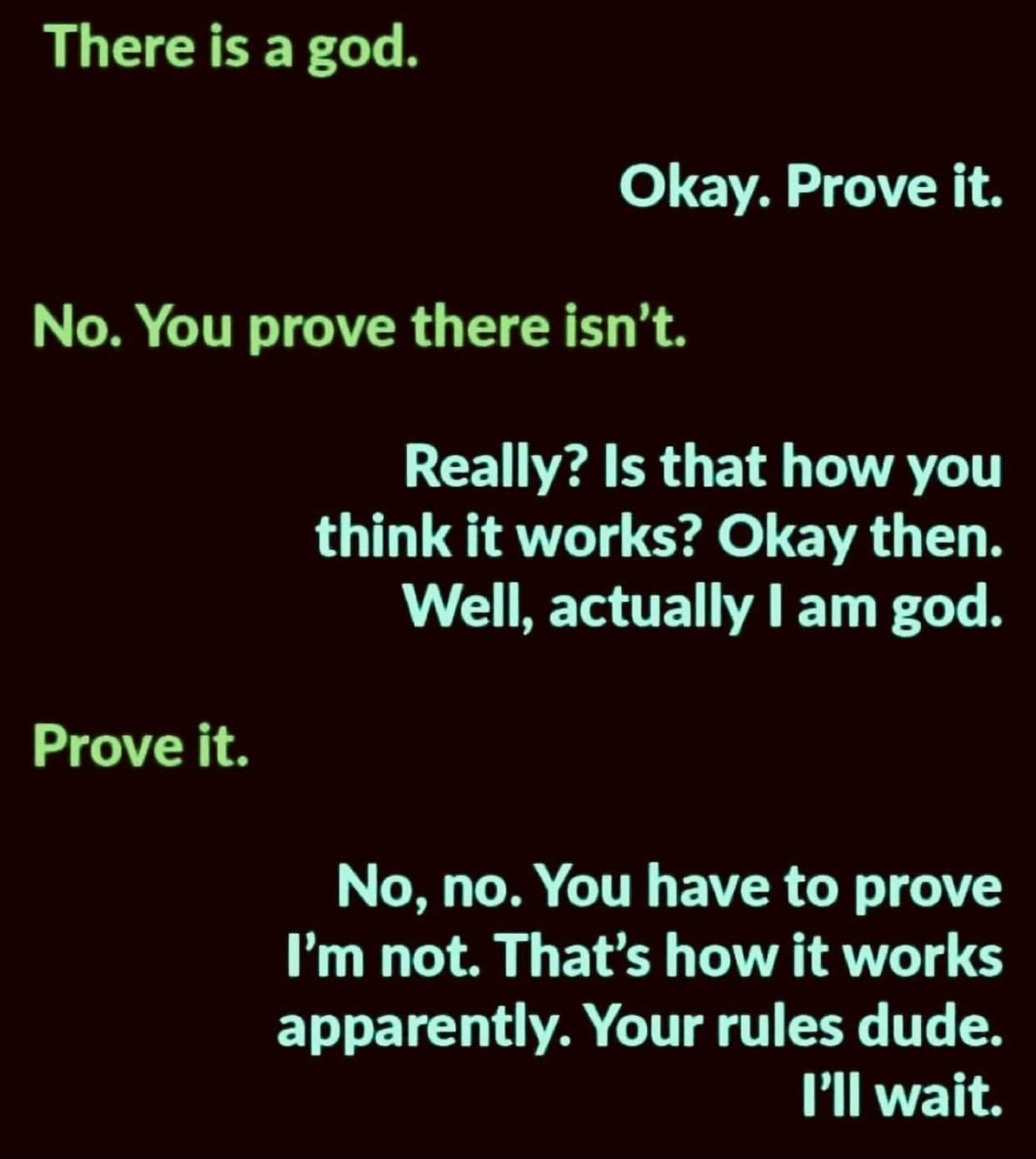
This reminded me of this joke I saw today:

5 Likes
I suppose it could be argued that the universe is so large, that anything (other than hard vacuum) is a minuscule part of it. But then I suppose the argument would become, if life was the whole point then why have such a large universe? It’s a bit like building a continent-sized sports stadium to have a small game of tiddlywinks in one corner (but more so).
2 Likes
I wrote a couple of articles on this topic for Uncommon Descent, back in 2011:
Hope that helps.
1 Like
Maybe the clue is in the vacuum and the gassiness. Perhaps what God is saying is that He is mostly vacuum and gas, and so one should expect all philosophical speculations about His existence to suffer from Random capitalization and Be vacuous and gassy.
I entirely agree that life made by a Deity need not be fine-tuned, but I would argue that there’s a plausible reason why a Deity might want to fine-tune life. As I argued in my post:
If fine-tuning is not required in order to generate the desired product (intelligent life), and if it is no easier for the producer (God) to make the product in that way, then the only possible reason for fine-tuning must have to do with God wanting to be known by us. In other words, God fine-tuned the universe because He wants us to discover His existence through the fine-tuning of the cosmos.
So the fine-tuning hypothesis should be stated as follows:
(FH) There exists a Being Who made the cosmos in order to produce intelligent beings who would discover scientific evidence of His existence, in the cosmos. By contrast, the null hypothesis denies the existence of a God Who wants to make Himself known scientifically.
Cheers.
2 Likes
I agree that the Fine-Tuning Hypothesis doesn’t get us to an omnibenevolent God. Indeed, one might argue that it merely points to a God Who wants some intelligent beings to detect His presence. Such a God might care little about plagues, so long as they don’t wipe out the entire human race.
Another point to consider is that the Designer of the laws of our universe may not be the same Being as the Designer of the first living organism in our universe (if there is one). One could imagine two separate designers, with the second spoiling the work of the first.
I wrote an article back in 2011 that may be of interest to you:
What Assumptions Does The Fine-Tuning Argument Make About The Designer?
Enjoy!
That’s just another blind assumption, no better than assuming a God would want to create life in the first place. So to get to the conclusion that the cosmos was created by God, we have to assume God would want to create life, and then we need to assume God would want to be known scientifically.
Of all the logically possible divine persons we can imagine, we must assume one that wants to create life, and that it desires to be known through the physical constants. I’m pretty sure neither of those assumptions are intrinsically more plausible, or economical, than their negations, or Gods that want non-physical lifeforms to know it through non-physical means.
1 Like
- If you don’t like the universe that we live in, then the onus is on you to show that a better universe is physically possible
A universe otherwise identical to ours where planets in the orbits of Venus and Mars were habitable is physically possible, and would triple the known capacity to support life. That’s possible with the current laws of physics, much less a different set.
Also and again, God could make life exist in a universe where life is impossible. So…
- Imaginability doesn’t imply physical possibility .
This is a great point. Against you.
That you can imagine other possible universes doesn’t mean they are possible. And if no other universes are possible, the fine-tuning argument falls apart.
- […] The Intelligent Designer might not want to
And again, that you can imagine what the Designer might or might not want is no help to anyone. Sounds like an excuse more than anything.
4 is the same as 3.
- Objections to fine-tuning are of no avail unless they are even more powerful than arguments for fine-tuning
Fine-tuning arguments require an extra entity. Such an inference requires necessity, which there isn’t since the observed universe is consistent with naturalism. So fine-tuning is already inherently less powerful at explaining the observed ‘fine-tuning’ than ‘nothing’.
6 is the same as 3 and 4. Were you just making stuff up to fill up a list?
7 is worse than 3,4 and 6, because it isn’t even an argument. It is a nothingness.
3 Likes
This is the silliest and least effective possible way of making himself known, and that seems like a problem to me. He should have tried what he does over and over in the bible: visit us and announce himself directly.
1 Like
You might try to ease up a bit on the burden-of-proof shifting, Vincent, as hypotheses can’t deny the existence of things–people do.
1 Like
Vincent, I saw you make the following claim in your article:
If you don’t like the universe that we live in, then the onus is on you to show that a better universe is physically possible , given a different set of laws and/or a different fundamental theory of physics. Only when you have done this are you entitled to make the argument that our universe is so poorly designed that no Intelligent Being could possibly have made it.
Let me turn this around for you:
If you Vincent and other fine-tuning advocates think that the universe that we live in is fine-tuned, then the onus is on you to show that no other universe with intelligent life is physically possible including both what different set of laws and/or a different fundamental theory of physics are physically possible (as you say, “imaginability doesn’t imply physical possibility”) and that no form of intelligent life, no matter how different from our own is possible in these possible hypothetical universes. Only when you have done this are you entitled to make the argument that our universe is so fine-tuned that only an Intelligent Being could possibly have made it.
I’d suggest that even a top-flight team of theoretical physicists, cosmologists and astrobiologists would find this a prohibitively difficult task. Given that most fine-tuning advocates tend to be armchair philosophers, I’m not holding out much hope.
It seems to me that declaring that we know enough about the fundamental physics of our universe to declare what hypothetical universes are or are not possible, or enough about what forms of intelligent life are possible, is case of towering hubris.
2 Likes
Given an omnipotent deity, what does “physically possible” even mean?
2 Likes
Not really.
Take your first point, for instance:
- If you don’t like the universe that we live in, then the onus is on you to show that a better universe is physically possible , given a different set of laws and/or a different fundamental theory of physics.
A better universe is physically possible with the same set of laws. For example, not having hot Jupiters that prevent the presence of Earth-sized planets in habitable zones around stars.
Your argument in the second article is even worse:
(c) The fact that the universe is mostly inhospitable to life has a simple explanation: a universe that was life-friendly everywhere would actually be less elegant, mathematically speaking, and hence less likely to be made by an Intelligent Designer. As Dr. Robin Collins has argued, the laws of our universe are extremely elegant, from a mathematical perspective. (See also my post, Beauty and the multiverse.) If there is an Intelligent Designer, He presumably favors mathematical elegance. Accordingly, the most likely reason why most of the universe is inhospitable to life is the recipe for making a big universe with a few tiny islands of life is mathematically simpler and morer elegant than the the recipe for making a universe with life everywhere, given the laws of Nature as we know them .
This is not only unsupported opinion about both the laws of the universe and the nature of the designer, but also goes against basic design reality: If elegant designs don’t work as well as inelegant designs, don’t use them.
Because if this is what the designer did, the universe is not fine-tuned for life, it’s fine tuned for elegance.
3 Likes
That’s not the only possible reason for fine-tuning, it’s the only possible reason for fine tuning if God exists.
Trying to come up with arguments for a false conclusion is doomed to failure because all such arguments will, by necessity, be flawed. Better to look for arguments that will determine whether the conclusion is true than to look for arguments that will show it is true. That way you avoid problems like the above.
2 Likes
I would guess an omnipotent deity would be able to do things that are not physically possible.
2 Likes
Then that’s not a fine-tuned universe. Its a survive-if-you-can universe.
This might be true but it has gotten silly at this point.
The nature of the designer’s intention are irrelevant to me. What’s most important to me is that our current universe is not fine-tuned for life. It wants to kill us but we fight against it on a daily and some parts of it (like our planetary magnetic field which staves off solar winds from the sun) are our allies.
1 Like
You are labeling VJT’s hypothesis an assumption. Does his hypothesis fit the evidence? How do we account for our technical progress? Does curiosity and inductive reasoning play a role in mans technological achievements? Does evil and sickness play a role in mans achievements? If God was visible does that change how people might seek to understand Him?
Two other arguments that are just as valid as the KCA:
- Everything that begins to exist has a cause.
- The universe did not being to exist.
- Therefore, the universe does not have a cause.
and
- Everything that begins to exist has a cause.
- The universe does not have a cause
- Therefore, the universe did not begin to exist.
I see no way to determine that either of these is unsound.
2 Likes
That said omnipotent deity doesn’t make their involvement too obvious?
I am pointing out that it has unsubstantiated assumptions. It’s like arguments with premises that aren’t supported. Same thing. You can argue the truth of any imaginable proposition by just assuming something that gets you your conclusion.
Any hypothesis, with the right assumptions, will. This is a bug, not a feature.
1 Like