Also known as ‘miracles’.
1 Like
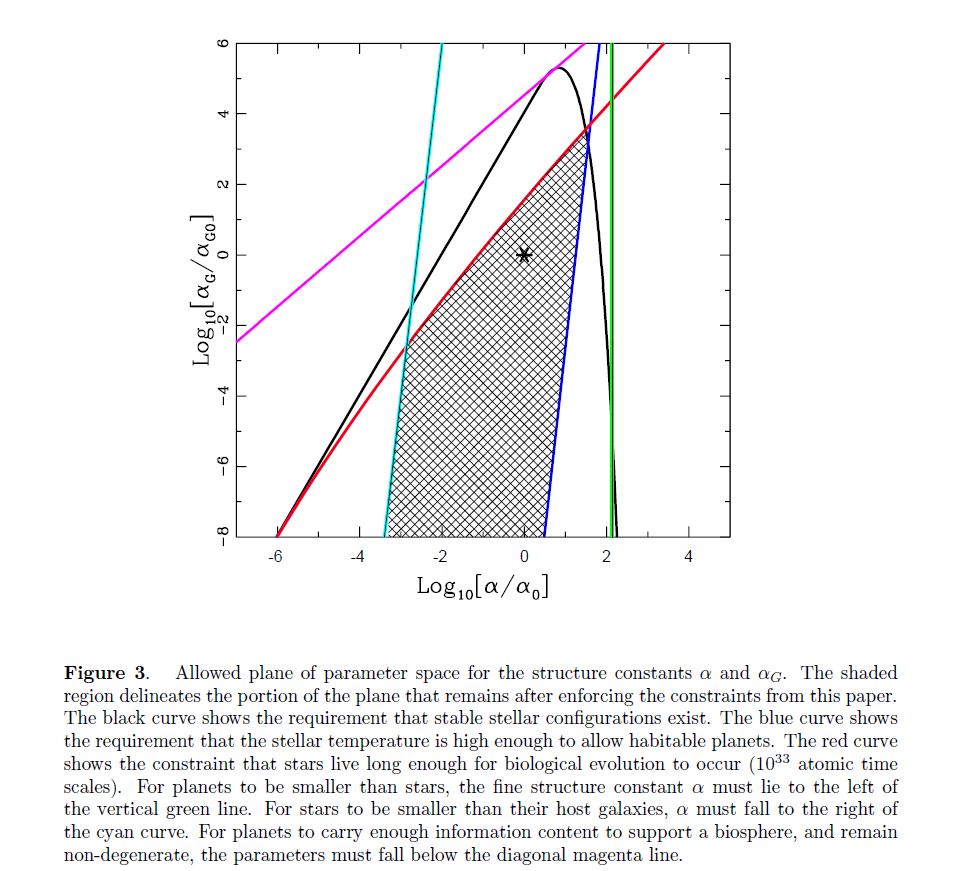
Tuning is not as fine as some think. Fred Adams at U of Michigan has calculated the ranges and ratios of several “critical” parameters and shows that, over several orders of magnitude, stable stars and planets can form and persist for time frames relative to life developing and evolving.
3 Likes
The first one isn’t valid.
(X → Y) -/-> (~X → ~Y). Denying the antecedent fallacy.
Everything that is a lemon is yellow.
Bananas are not lemons.
Therefore bananas are not yellow.
4 Likes
Yikes! Just realized this is not valid.
- should be “Therefore the universe may not have a cause.”
Yes, realized that but too late.
I think you are contradicting yourself here.
If the hypothesis is wrong contradictory evidence will start to appear. Validation of a hypothesis is showing it fits the evidence. The hypothesis of a universe created for discovery and innovation appears to fit the evidence. I think this is one of @vjtorley best arguments.
Then you are mistaken.
Assuming someone looks for that evidence, that such evidence even exists, and that it can be found.
No, validation of a hypothesis is testing it’s predictions against future observations. Any hypothesis can be made to fit currently collected observations with sufficiently numerous and complex assumptions. As I was saying.
Because it was tailor-made for that purpose. The assumptions required to make it fit were just taken for granted. It predicts nothing and can’t be tested. All it does it make up an untestable reason for why the data we currently see is the way it is: God did it because He wanted to.
Wow, what a great hypothesis. It’s operationally indistinguishable from it just is that way for no reason.
I think that says a lot about you.
5 Likes
It seems to me that you are the one that is confused here for premise 1 of the kalam argument doesn’t imply that the universe began to exist from nothing, not at all. In fact, it states the exact opposite, ie., that everything that begins to exist has a cause, be it material or not. And by denying this premise, you are then forced to accept the opposite claim that there are some things that can begin to exist without a cause, which is to say that they are some things than can come into existence from nothing. IOW, by denying premise 1 of the kalam argument, you are the one who is guilty of the sin you attribute to me.
Regarding the kalam cosmological argument, how do you regard premise 1?
You’re right. However, isn’t the case that from premise 1 below, the conclusion holds?
Premise 1: the universe did not begin to exist.
Conclusion : therefore the universe does not have a cause.
The FTA has always intrigued and appealed to me. I do not think it can be dismissed, but neither do I find it convincing as an apologetic. To me personally it points to purpose in nature, but I accept it is perfectly rational to hold otherwise.
I’m in rough agreement with @vjtorley that the size and age of the universe is not a counter argument against fine tuning. Relative scale does not equate to relative significance. Furthermore, while my hunch is that life is scarce and civilizations very rare, that could be wrong and both may be quite commonplace, in which case the vastness of it all becomes less superfluous. The Intelligent Design community embraces both Fine Tuning and Rare Earth, without recognizing that there is actually a tension there.
The FTA has its origins and definition in neither theology nor philosophy, but in physics. Fine tuning has implications for scholastic apologetics, but its essence concerns the degree of latitude permitted the physical constants while still being compatible with existence - not of God, but of life. Coming from that direction, the scale and age of the universe is essential because under the rules as we find them, that is what it takes to yield our rocky, water-covered world populated with carbon based life. The focus of the FTA is not concerned with theodicy or divine optimization at all, these implications only arise when the FTA is incorporated into theological discussion. Defending the FTA against counter arguments misses the point that the FTA is not in itself an apologetic to begin with.
Fog and instant bang-crunch and many other imaginable universes have in common that they have no consciousness of their own existence. Even if materially there, in terms of awareness they would not exist. The question is how particular are the physical constants to arrive at bits of the universe developing the complex structures required to be self-aware. The core of the FTA is a physics problem as to whether the constants are tuned at all, and if so, what might account for that observation? Being as this question is at the ultimate fringe of physics, purposeful creation is on the table; but alternative explanations of varying credibility have had the backing of many physicists, including those who framed the discussion to begin with. These approaches include brute fact, “puddle” arguments such as the anthropic principle and multiverses, and more Treky ideas of Gaia universes.
As to Intelligent Design, the irony is that design detection is predicated on the idea that nature is not fine tuned at all, but is hobbled and insufficient to account for life. ID is contrary to fine tuning.
Interesting paper, and in principle exploring alternative universes is a worthwhile endeavor to yield insight. However, there are a lot of prerequisites for life beyond these, and I think as they’re considered in total the degrees of freedom would narrow. As the author himself states:
The current stellar structure calculations are also limited to the hydrogen burning phase, i.e., we consider the fusion of only one nuclear species. The production of heavy elements, including carbon and oxygen, place additional constraints on the fundamental constants, and thereby narrow the allowed range of parameters.
Stellar nucleosynthesis of heavier elements, and properties of elements, would pose significant further constraints.
Sorry for the “no you”, but premise 1 is that “Everything which begins to exist has a cause”.
Premise 2 is that “the universe began to exist”.
These two premises are supposed to work together to entail the conclusion that therefore the universe has a cause of it’s beginning to exist.
This is where Craig will typically argue for the truth of premise 2 by reference to big bang cosmology, which Craig argues shows that the universe began to exist out of nothing. Ex nihilo. He does this among other things because he thinks this is evidence for the Christian view that in the beginning there was nothing but God, that is to say that the universe did not even exist, and that God created the universe out of nothing.
If you are making a different argument than Craig is, by all means please elaborate. In what sense do you think the universe began to exist, and what evidence do you have to support that beginning? And what is it that is supposed to have occurred that requires a cause to facilitate?
And I have a problem with the premise that everything that begins to exist - whether from pre-existing material or from nothing - has a cause. Because I only really know of things that have begun to exist from pre-existing material. But I have no experience of things being caused to exist from nothing. So I don’t think the claim - that such beginnings must also require causes - to have met the burden of proof.
And to make matters worse I don’t see any reason to think anything ever began to exist from nothing.
I don’t think beginning to exist from nothing requires causes, why should I think that?
I don’t think the universe began to exist from nothing, why should I think that?
No. It is technically possible for a person to remain unconvinced of the truth of the assertion that beginning to exist from nothing must have a cause - without that entailing an assertion or a claim to know that no such cause is required. I’m the sort of guy who takes convincing. I want to be compelled by good argument and evidence, but you seem to be lacking in argument and evidence that things coming into being out of nothing must be caused to do so.
In fact I’m not quite sure how that could even work, since if something does not even exist, one has to wonder how it can be made to do anything at all, such as beginning to exist.
I’m not quite sure what sin I have attributed to you, other than perhaps an unwarranted extrapolation. But I’m quite certain I have not committed that myself.
2 Likes
I fully agree that Adams’ paper does not address many other problems, including stellar nucleosynthesis of heavier elements. His work does however show that there are fruitful pathways to scientifically explore the real limits of life-friendly universes.
2 Likes
No.
1 Like
This is trivially false.
Denying a premise does not require stating that the premise is false - only that the premise may be false. So denying a premise does not require accepting the opposite claim.
Someone who does not understand this simple point is not fit to determine anyone else’s shortcomings in logic.
3 Likes
As you often do you have reverted to a straw man argument. The hypothesis is specifically about discoverability and the confirming evidence.
It is predicting the evidence will confirm the Universe is built for discovery. Do you have an argument that it is not?
How would you confirm such a thing?
1 Like
That’s not a scientific prediction. Scientific predictions are about what you will directly observe, not how you (or anyone else) will interpret the evidence.
We bake the interpretations into scientific hypotheses. You lack sufficient confidence in your hypothesis to do so. Why is that?
3 Likes
How, by scientific experiment and empirical observation, does one discover a transcendent God? Can you capture God in a flask?
1 Like