I observe a useful function and observe agency from this observation. You are welcome to challenge this inference as there are exceptions to it. A rain cloud has a useful function but I can attribute this to natural causes only. So in this case I would not infer agency.
I do not care to have to explain to you how usefulness is subjective, too, and see you struggle to come up with an example where “useful function” and “function” are not the same thing in practice. I’ve been letting you pull me by he nose for long enough, and I’m being plenty generous enough to follow your shift of definitions as it is.
A piano maker has a purpose for making the piano – to sell it. A piano player has a purpose for the piano – to play it. A musical instrument collector has a purpose for the piano – to own and presumably display it. The piano does not have a purpose, because it has no intention, because it is not a person. It has functions: It can serve a decorative function, an instructional one, it can aid an artist in expressing themselves, or in earning a living, it can even be a makeshift table. Or an oversized door stop.
Oh, my bad. So it’s even worse than “Thing exists, therefore agency”. That would at least have been consistent, but no. Instead it’s rather “Thing exists, therefore agency, unless thing exists and I arbitrarily decide that maybe not therefore agency”. A rain cloud, something with a “useful function” that happens to be governed by thermodynamics, that’s a perfectly natural phenomenon that warrants not the inference of an agency, apparently. But an atom, something with a “useful function” governed by quantum mechanics, now that’s somehow totally different, that clearly does warrant inferring an intelligent agency.
See, I was being charitable, I thought you had some really really bad standards that result in your preferred conclusion basically no matter what the evidence is. But it’s even worse. In actuality you have no standards at all, and will conclude both your favoured hypothesis and its negation more or less at entirely random!
2 Likes
Clearly an uncredited cut-and-paste, since it’s a coherent, meaningful sentence. But I have a response to Bill’s claim here, recycled from a response to one of Wells’s “Icons of Evolution”.
Wells: Why do textbooks define homology as similarity due to common ancestry, then claim that it is evidence for common ancestry — a circular argument masquerading as scientific evidence?
This question stems from confusion on Wells’ part between how something is defined and how it is recognized, which are two quite different things. Homology is indeed defined as similarity due to common ancestry. But we don’t just label any similarity a homology and call it evidence for common ancestry. That would indeed be circular. What we really do is quite different. Similarity between the characteristics of two organisms is an observation. If the similarity is sufficiently detailed (“both are big” or “both are green” won’t do) we consider it a candidate for homology.
Homologies can be tested to some degree by predicting that the characters will be similar in ways we haven’t yet checked. For example, if we propose that similar-looking bones in two animals are homologous, we might predict that they would arise from similar precursors in the embryo, have similar spatial relationships to other bones in the organism, and have their development influenced by similar genes. And this is commonly the case.
But the main way of testing candidate homologies is by congruence with other proposed homologies. By congruence we mean that the two characters can plausibly belong to the same history. If the history of life looks like a tree, with species related by branching from common ancestors, then all true homologies should fit that tree; that is, each homology should arise once and only once on the tree. If a large number of functionally and genetically independent candidate homologies fit the same evolutionary tree, we can infer both that the candidates really are homologies and that the tree reflects a real evolutionary history.
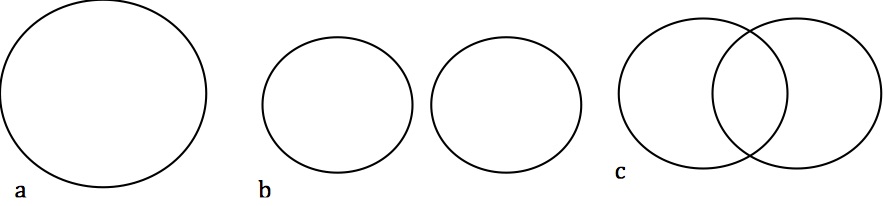
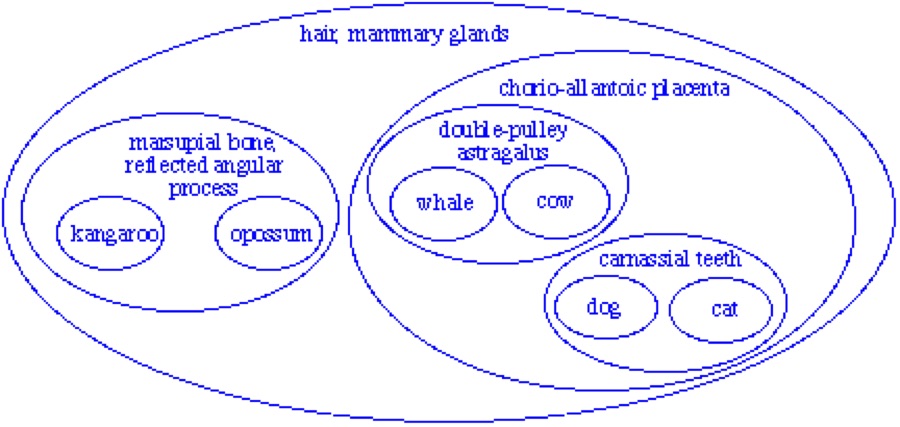
And in fact that’s what we commonly find. Mammals, for example, are inferred to descend from a common ancestor because they all have hair, mammary glands, and other more obscure characteristics like seven neckbones and three earbones. All these characteristics go together: mammals have all of them and no other animals have any of them. Further, other characters support consistent groupings within mammals, and groupings within those groupings. Within most of life, groups are organized in a very special way called a nested hierarchy. In a nested hierarchy, every group is related to every other group in one of two ways: either one group entirely contained within the other (as in a below), or they share no members at all (as in b below). No two groups can partially overlap (as in c below).
What we see if we try to organize species using candidate homologies is that groups organized according to different characters fit together like a and b, but not c, so we get a pattern like this:
Why should these and many other characters all go together in this consistent way? Evolutionary biology explains these characters as homologies, all evolved on a single tree of descent, like this:
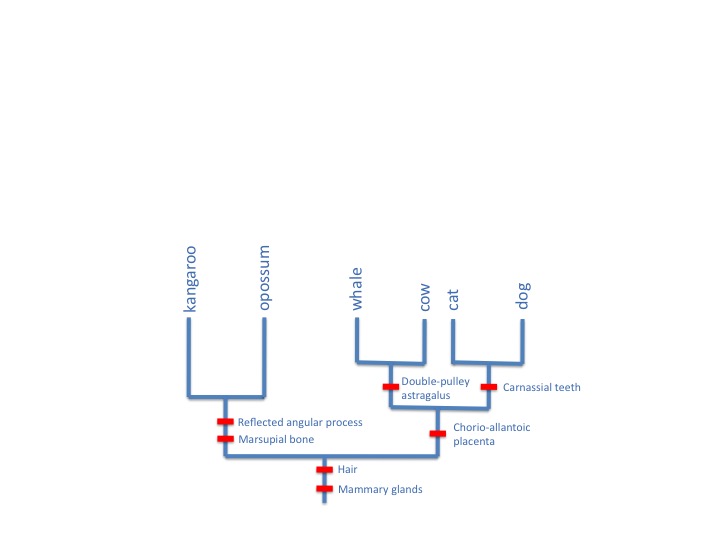
Wells gives no alternative explanation for such patterns, and indeed they are hard to explain in any other way than as reflections of an evolutionary history. Wells has it all wrong. Homology isn’t a circular argument, it’s a branching tree of evidence.
4 Likes
So useful functions cease to imply agency when we are no longer ignorant?
2 Likes
All useful functions, identified and known by people, have a “defined” usefulness. Those not identified by or known to people do not have defined usefulness, because there’s nobody to “define” the usefulness. But none of that has the slightest thing to do with “purpose.”
The problem of course is Behe uses the word “purpose” in two wholly different senses. One means merely “function,” and does not indicate design. The other means “purpose,” and does indicate design. So what he does is find “purpose” in the first sense (meaning not purpose, but function), and then, because “purpose” in the second sense entails design, he concludes that the presence of this purpose indicates design. But one cannot use two inconsistent definitions in that way and construct a valid argument. “Purpose” in sense 1 does not entail the attributes that belong only to “purpose” in sense 2. That this is so is just screamingly obvious.
One can use “purpose” in its ordinary sense. Used in that sense, Behe cannot find “purpose” in the structures in living things, and therefore cannot move along to the inference that those structures are designed.
Or, one can use “purpose” in Behe’s “not really purpose, but only function” sense. I don’t recommend it, but I suppose one can harbor that sort of definition of a word as literally not meaning what that word means. In THAT case, Behe can find “purpose” (i.e., function) all over the place in living things, but no design inference follows.
You cannot, however, take one from Column A and one from Column B here.
5 Likes
Not for truth’s sake?
1 Like
I don’t even know what numbers are being counted here. What does “Over 10% did not including two mammal species” even mean?
1 Like
I may be being cynical here, but I cannot help but suspect the deciding factor in whether a “useful function” is declared a “purpose” or not is not how usefully functional (or functionally useful) it is, but how blindingly obvious it is (to a layman) that the useful function is merely happenstantial.
IDers have a lot to answer for.
FTFY
Citation, please to a single study where researchers attempted to have bacteria evolve a flagellum in the lab.
1 Like
I think that was Behe’s own idea – from his Dover testimony, I think.
Addendum:
As a further example, the test for ID proposed by both Professors Behe and Minnich is to grow the bacterial flagellum in the laboratory; however, no-one inside or outside of the IDM, including those who propose the test, has conducted it. (P-718; 18:125-27 (Behe); 22:102-06 (Behe)). Professor Behe conceded that the proposed test could not approximate real world conditions and even if it could, Professor Minnich admitted that it would merely be a test of evolution, not design. (22:107-10 (Behe); 2:15 (Miller); 38:82 (Minnich)).
– Dover decision
Nick Matzke wrote several paper proposing an evolutionary pathway. Not a LAB experiment but trying to challenge Behe’s design inference.
So your claim was simply false. Why make it?
Demonstrating a possible evolutionary pathway trying to show the design inference is not necessary. Why are you quibbling?
Why are you deliberately making false statements? You claimed that scientists were trying to evolve flagella in the lab. Name them or retract your claim.
It’s the way of the sealion. You can’t change him.
That is Faizal’s statement. I did not say anything about a Lab. Why are you making stuff up?
It is not at all clear that Matzke’s work has anything to do with Behe’s long-debunked and long-forgotten “design inference”.
… and eventually I somehow got a job in New Zealand and occasionally find myself involved in not entirely dissimilar debates there. And also somehow found collaborators that wanted to work on the bacterial flagellum, and somehow happened on some new methods using protein structure to enhance phylogenies that are letting us make progress that was previously not imaginable.[1]
A reminder for Bill.