Ah, but to properly employ the ‘Sal Cordova quoting technique’TM it should be
The emergence of complexity more perfect than we imagined is via ordinary processes - Sal Cordova
Ah, but to properly employ the ‘Sal Cordova quoting technique’TM it should be
The emergence of complexity more perfect than we imagined is via ordinary processes - Sal Cordova
Nope, Minnich started with the K-12 strain that didn’t have the defect of the B strain that Lenski used that had a defective dcuS gene.
There was a 5-base pair frame shift inducing deletion mutation in the dcuS gene of E. Coli B that isn’t present in K-12. If misnomered “natural selection” acted in the way Dawkins Weasel suggested, it could have reconstructed the dcuS gene quickly and restored the gene. But that didn’t happen in practice because Dawkins Weasel doesn’t represent experimental reality, it’s the way Dawkins and Darwin and many evolutionary biologists fantasize how evolution builds complexity by accumulation of slight successive modifications.
This shows that so-called “natural selection” acting on mutations can’t work with the requisite foresight to reconstruct a formerly working gene, much less should it be expected to build something as complex as other new 4200 base-pair genes that code for 1400 amino acid proteins. Gene loss is devastating, and given the scarcity of creating complex integrated (especially multimeric-dependent complexity), this isn’t indicative of an overall trend that would be evolve a microbe into a primate.
Worse for Lenski, rather than reconstituting the dcuS gene, he needed the dctA gene to be blown out. And then he got mutator strains that compromised gene repair, and those got selected, and then those lost even more genes!!!
So lenski evolved strains that lose genes and won’t survive outside coddled lab conditions. And that’s something to crow about?
Evolutionary claims are analogous to someone who lost all his possession in a casino and he reflects on the time he won on the slot machine.
Roth said:>
Van Hofwegen et al. demonstrated that Escherichia coli rapidly evolves the ability to use citrate when long selective periods are provided (D. J. Van Hofwegen, C. J. Hovde, and S. A. Minnich, J Bacteriol 198:1022–1034, 2016, https://doi.org/10.1128/jb.00831-15). This contrasts with the extreme delay (15 years of daily transfers) seen in the long-term evolution experiments of Lenski and coworkers. Their idea of “historical contingency” may require reinterpretation. Rapid evolution seems to involve selection for duplications of the whole cit locus that are too unstable to contribute when selection is provided in short pulses.
I interviewed Dr. Minnich here regarding his experiment:
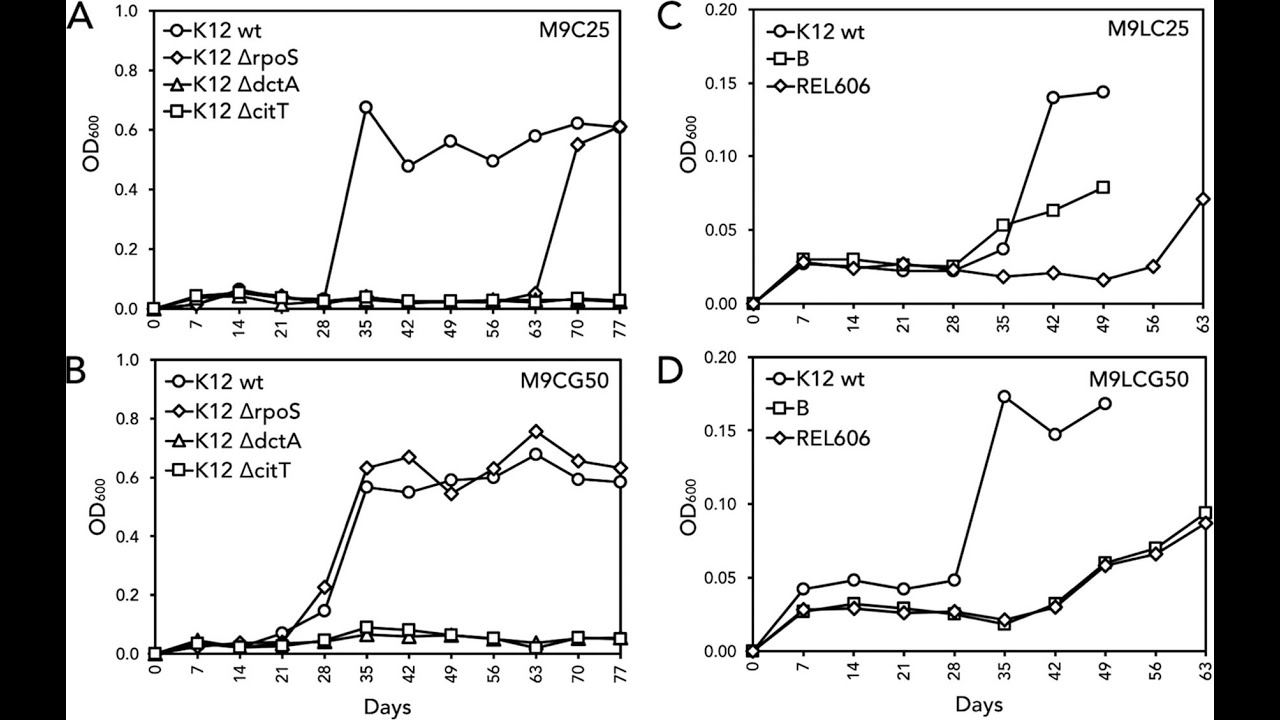
Gain of function came at the loss of versatility (as in compromising other functions useful in a variety of environments).
So I didn’t get it wrong Rumraket.
Lewontin is a great example of the extreme cognitive dissonance that is abundant in evolutionary biology.
Hi Rum
Do you really believe this is more than a speculative claim that gene duplication and divergence forming new genes happens a lot?
What other mechanisms do you think can generate new genes?
Nice to see you Bill!
Irrelevant to your statement that natural selection doesn’t help in evolving the Cit+ trait.
You said selection wasn’t able to help in evolving the Cit+ trait, which you contrast as having taken 15 years in the LTEE vs a period of several weeks by Van Hofwegen et al. That makes it clear it’s the Cit+ trait that matters, and that you think selection doesn’t make a difference.
That you are incorrectly obsessing about target series of mutations—the exact way in which Dawkins WEASEL also is unlike reality as we have all been saying now for decades—is your own fault. The trait evolved, and selection made a colossal difference in how fast that happened. That it didn’t happen by incrementally resurrecting a broken gene, or by re-evolving by the same series of mutations that happened in the LTEE is completely irrelevant. The trait evolved and natural selection made a huge difference.
So Dawkins was right about selection making a huge difference in times to adaptation in reality (this time in a concrete real-world experiment), but his program had the same shortcoming your own thinking displays: You think there are targets. There isn’t.
If you treat the dcuS gene as a target that can be sort of incrementally restored. In that respect Dawkins program is unrealistic. Evolution works because cumulatively fixing adaptive mutations in effect just finds some path to an adaptive trait (in this case the Cit+ trait), it doesn’t somehow try to find a specific target (or a specific path to it.)
No. Biologists agree that the Weasel with it’s target is unrealistic, but what is realistic about it is that accumulating slight successive modifications under selection really does make a huge difference to the time it takes an adaptive trait to evolve. What happened in the experiment with strong selection was much faster than in the LTEE. As your new favorite authority John Roth explains in his article, that is why it evolved faster in the Van Hofwegen et al. experiment.
Sorry that the example you invoke so utterly debunks your own talking points. Yes, Dawkins weasel program has an unrealistic shortcoming, but you’re still wrong about selection not making a difference. It has been proven empirically, by direct “observational science” in the Van Hofwegen et al. experiment, that it makes a colossal difference. Numerous slight successive modifications fixed under strong selection made the Cit+ trait evolve in weeks, instead of 15 years.
Sorry buddy, off you go.
I recommend you peruse the fifty or so topics in which you’ve had this directly tutored to you by about a dozen people over half a decade.
Yes and it’s well said. Selection makes a huge difference.
You just can’t catch a break from getting pummeled by your own sources. No wonder you always truncate and lift sentences out of context. LOL
I recommend you stop making exaggerated claims you cannot support beyond speculation.
In the words of @John_Harshman your opinion means nothing.
Go be butthurt elsewhere. 
Bill has difficulty accepting that gene loss happens and is then inherited by the descendants of the organism that lost the gene. Since you seem to think that gene loss is pretty much all that ever happens, maybe you could set him straight.
So you pick what you like, appealing to authority when it suits you and dismissing that authority when it suits you. So typical of cargo cult science.
Are you still going with “old earth, young life” or do you now have a different idea of earth history? If the latter, what is it?
Ah, quote-miining. Your opinion means nothing, both that there is no reason to respect it and that often it conveys no meaning. Neither of these necessarily apply to anyone else’s opinions, which may be both informed and clearly expressed.
Good point. Bill must really hate Behe’s book Darwin Devolves and find this new and altered definition of Genetic Entropy, provided by Sal, to be extremely wrong and misguided.
But they’ll now take turns high-fiving and metaphorically fellating and stroking each other. And Sal spoke about cognitive dissonance. Someone get me a saw for the irony.
In the words of @John_Harshman your opinion means nothing. It’s only supported arguments that have value. Why are you backing off your claim? Why are you not flagging @Rumraket for his unsupported assertions and @Faizal_Ali for his general lack of comprehension?
I know it was Sal who veered off his own topic first, but have we not explored gene loss and gain and Venn diagrams in enough threads already? Maybe lets talk about fitness.
Hi Ron
The question is if superior fitness itself can generate new genes over time. Is this not one of the claims being contested in this op?
Fitness reflects in the selection for variation, not the generation of variation. So no.
No. What a ridiculous thing to say. Do you honestly believe evolutionists claim that “superior fitness itself can generate new genes over time”?
Both of those exist only in your fantasies. That’s why.